
Prediction beyond observed states
Virtual cells must forecast cellular change under biological context and intervention.
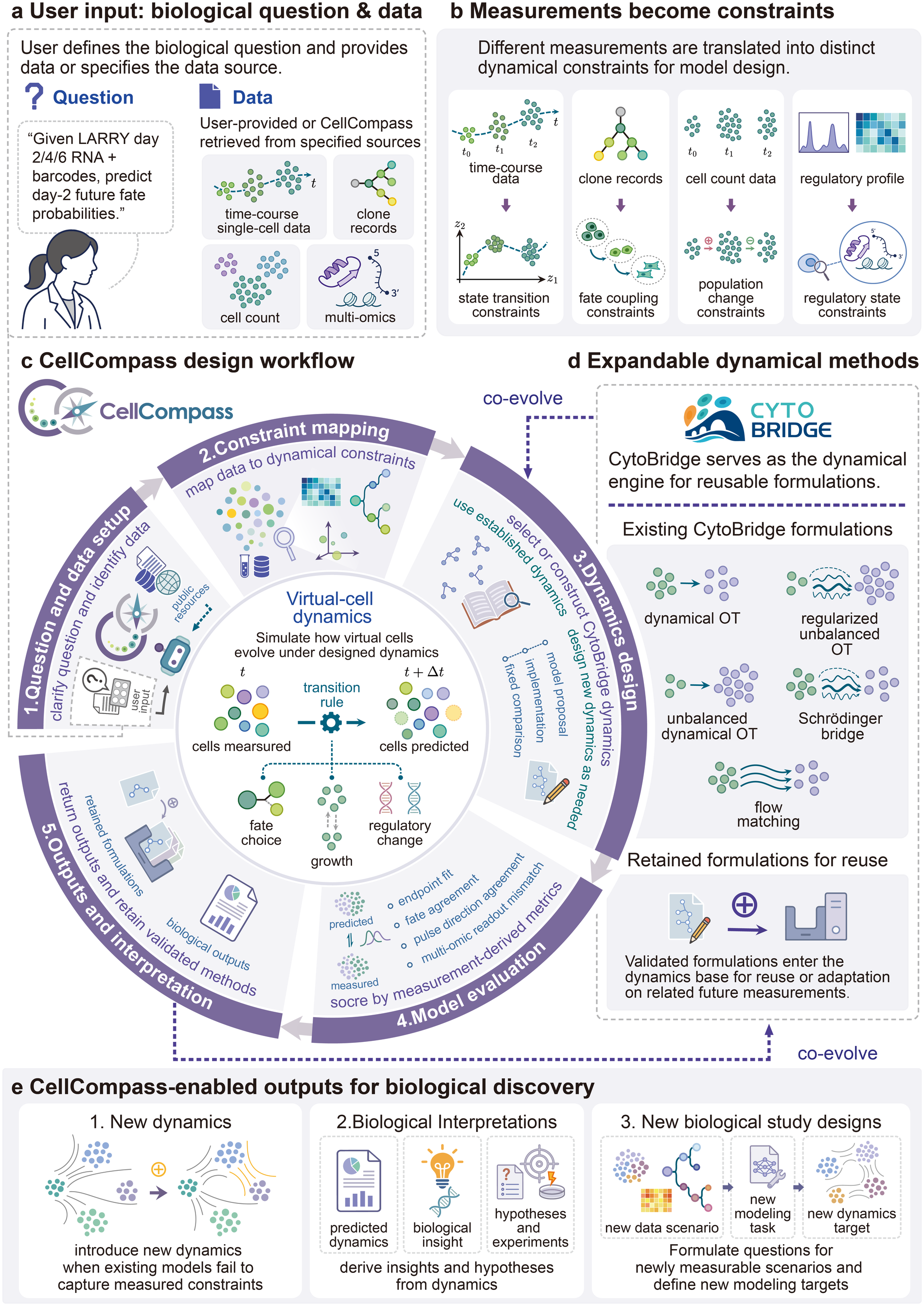
Virtual cells must do more than represent observed states — they must predict what happens next. CellCompass determines when existing dynamics are sufficient and when evolving measurements require a new model to be designed, tested, and retained.
A hand-drawn sketch of the idea — a cell on the bench, an atlas streaming into the machine, and the design cycle that draws new dynamics as new questions arrive.
Grounded in benchmark and real-data evidence

The premise
Single-cell technologies can now capture cellular state, history, response, and molecular context at scale. But the dynamical models used to predict future states generally remain fixed. This creates a growing gap between what experiments can reveal and what virtual cells can predict.
Virtual cells must forecast cellular change under biological context and intervention.
Each new experiment can expose a relation that existing dynamics cannot express.
Scientific capacity should grow across studies instead of restarting from one-off solutions.
The modeling principle
Sampled marginals constrain how populations move between observed time points.
transportLineage barcodes force the dynamics to preserve hidden fate divergence.
fate massProliferation and apoptosis reshape balanced transport into mass-changing dynamics.
unbalancedRNA and protein readouts require trajectories that carry molecular programs across modalities.
RNA → proteinCellCompass extends agentic AI from analyzing data and choosing among fixed models to constructing, testing, and retaining mechanistically structured dynamics. Pulse labeling, lineage tracing, and paired RNA–protein measurements each exposed a relation that existing dynamics could not preserve — and CellCompass converted those gaps into reusable models.
Newly synthesized and pre-existing RNA became constraints on staged cancer drug-response dynamics.
Clone records became fate dynamics that preserve hidden divergence between transcriptionally similar cells.
Paired RNA–protein measurements became RNA-initialized dynamics that generate future surface-protein states while preserving paired structure.
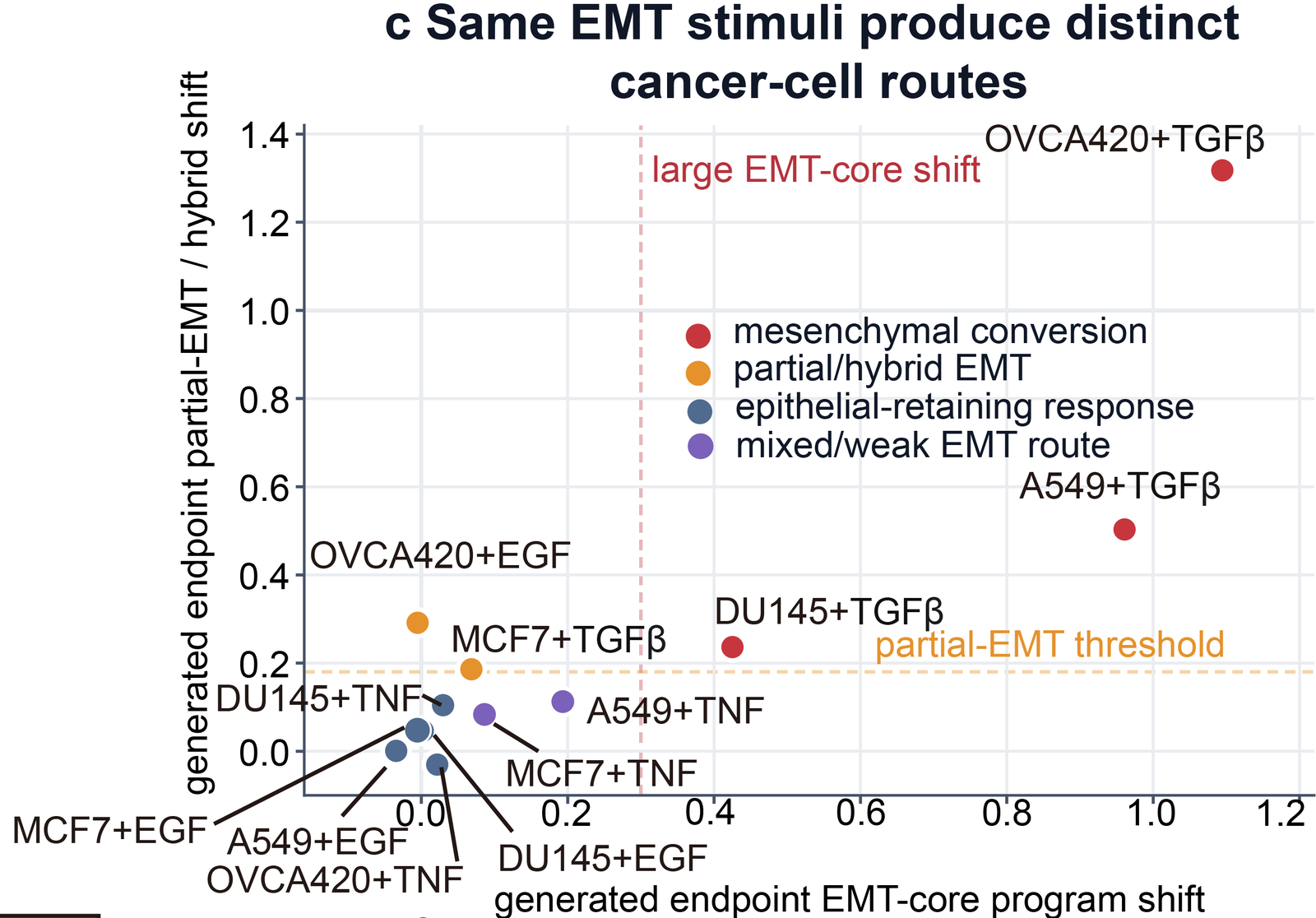
For epithelial-to-mesenchymal transition, CellCompass retained the existing velocity–growth formulation and reconstructed 12 context-specific trajectories across four cancer cell lines and three stimuli.
CellCompass moves beyond analyzing data, writing code, or selecting among fixed models. It constructs new mechanistically structured dynamics, evaluates them against the biological relation that motivated them, and turns each confirmed result into a reusable capability.
Proposes, implements, and tunes brand-new dynamical-modeling algorithms inside isolated, version-controlled workspaces.
Literature & theory-book RAG over optimal transport and flow matching informs every modeling decision with citations.
New methods register as first-class models on the open CytoBridge engine — reusable for simulation and downstream analysis across datasets.
Every candidate is tested against the future relation revealed by the experiment, with automatic promote / reject against baseline gates.
A registry tracks every proposal, snapshot, decision, and locked release as the single source of truth.
Guarded subprocesses, timeout & OOM protection, and durable checkpoints let a campaign run for days and recover itself — the agent never crashes.
CytoBridge supplies the mechanistically structured foundation that CellCompass can reuse or extend. Velocity, growth, stochasticity, and interaction are explicit modeling choices rather than hidden behavior inside a black-box predictor.
The learned drift, growth, diffusion, and density-dependent interaction kernel transport ρt between observed time-points. The interaction term follows the mean-field McKean–Vlasov formulation for collective cell dynamics.
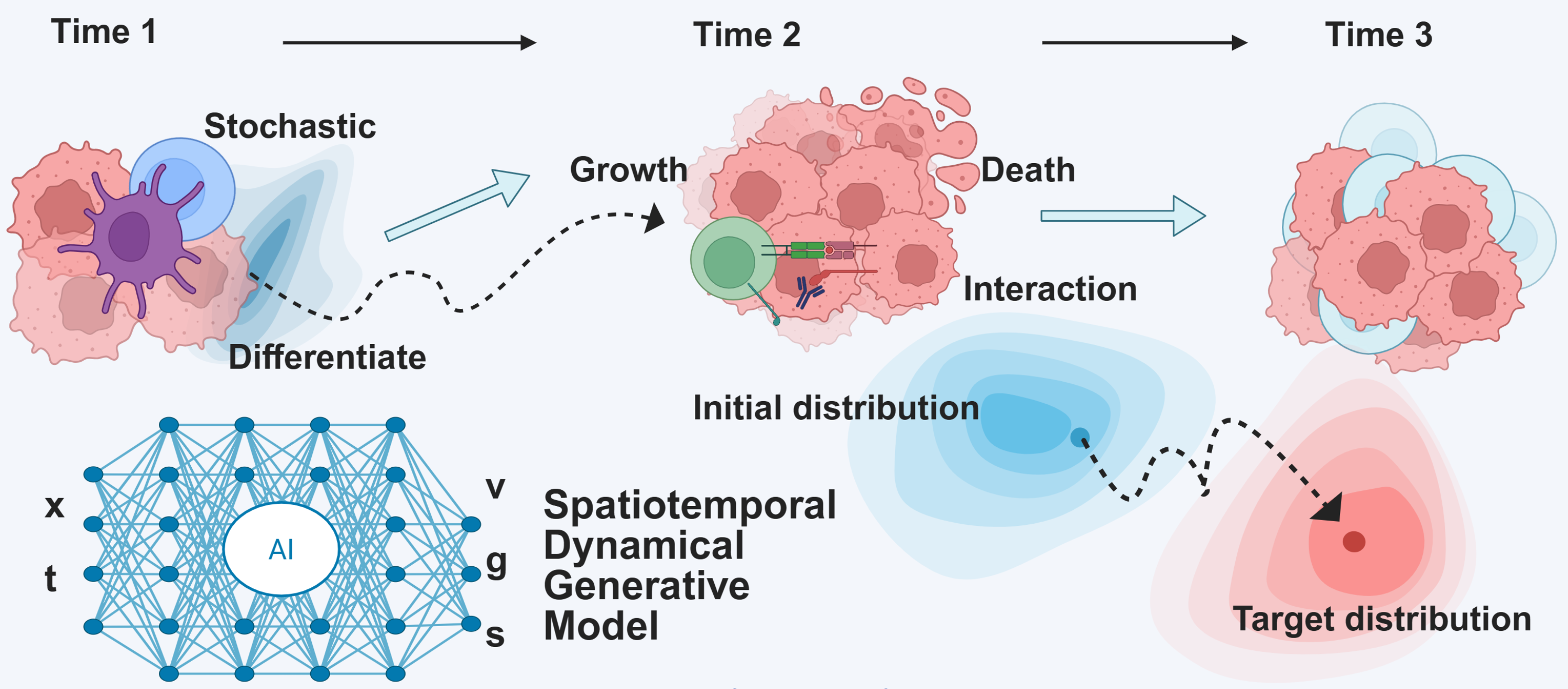
The spatiotemporal dynamical generative model — velocity, growth, score, and interaction transport an initial distribution to later time-points.
DynBench100 uses controlled ground truth to test dynamical reasoning across velocity, growth, held-out distributions, fate probabilities, perturbation response, and gene-regulatory recovery. CellCompass achieved the highest aggregate performance among the tested coding and biomedical agents.
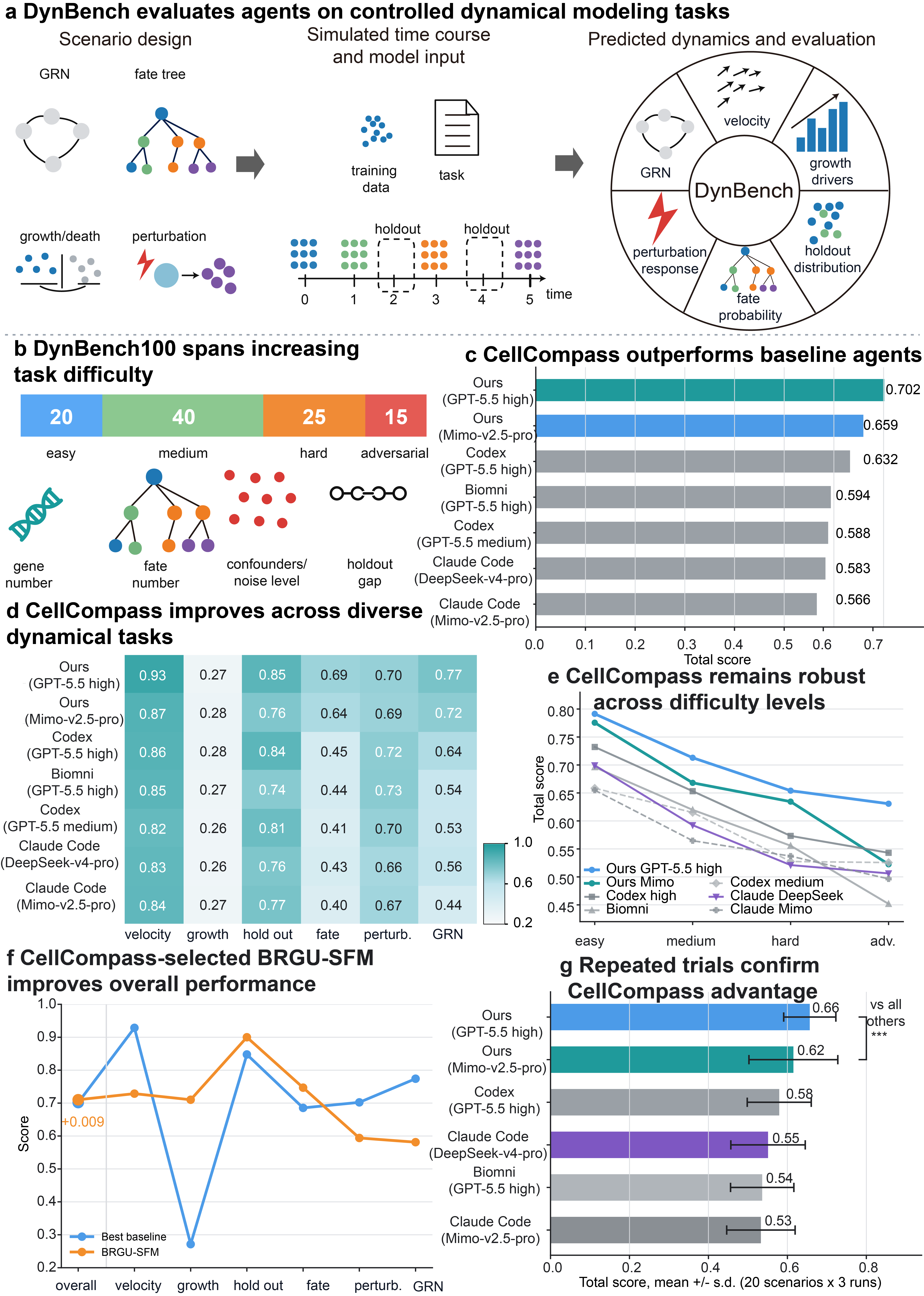
A new measurement exposes a predictive gap; CellCompass proposes and implements a formulation, tests it against the motivating relation, and locks the validated model into the reusable dynamics base.
A dataset where growth, stochasticity, or cell–cell interaction is poorly captured by existing dynamical models.
t₀, never future observed targets — no metric hacks.Each replay follows a design campaign from the motivating experimental relation through competing formulations, scored trials, and baseline gates to a confirmed release. Every trial is retained, making the path to PulseBridge, LineageBridge, and ProteinBridge inspectable rather than a single-prompt result.
CellCompass designed ProteinBridge around CITE-PCFM: a model that starts from RNA and generates time-resolved ADT surface-protein states.
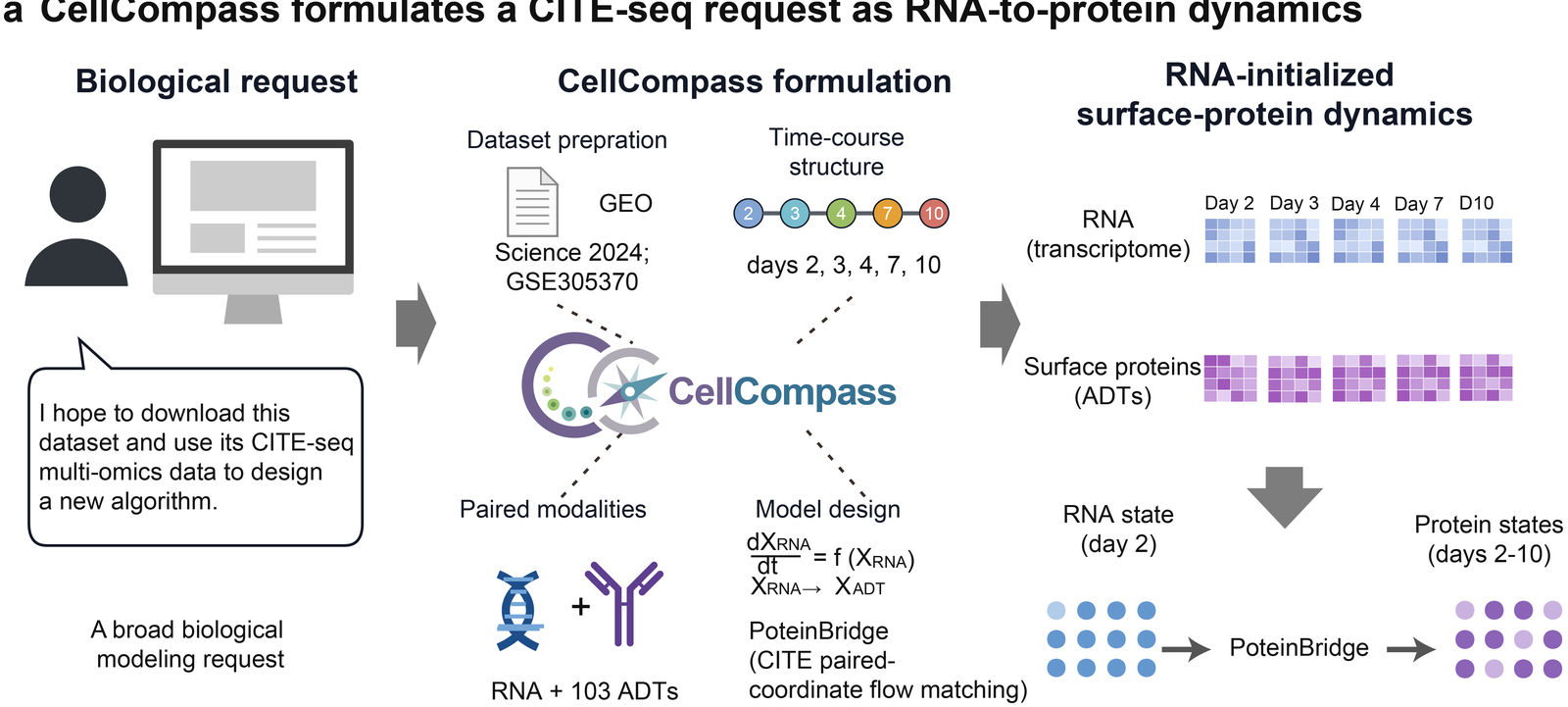
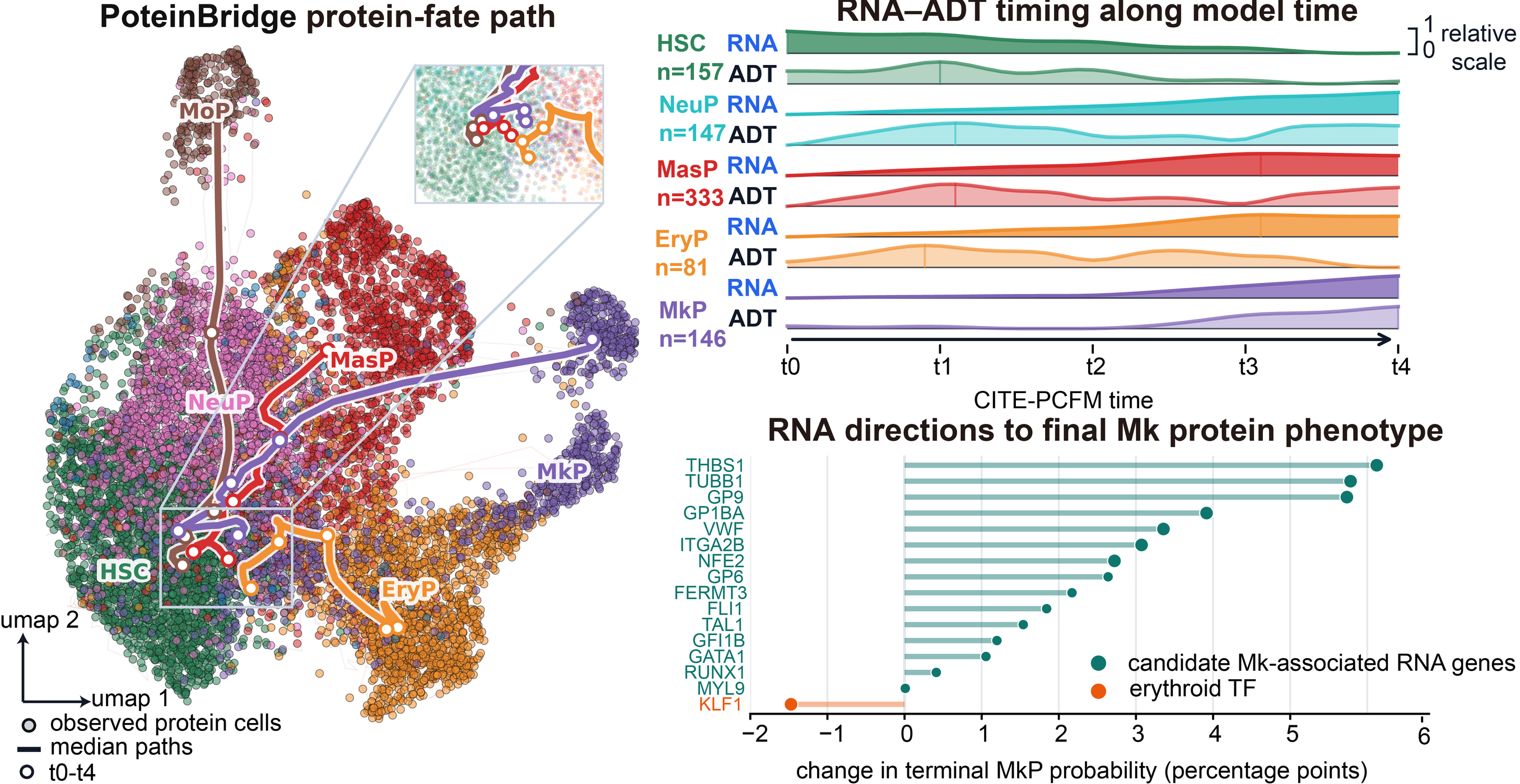
The upper chart zooms into CITE-PCFM tuning. This panel replays the broader search across candidate algorithm families.
The adequacy decision is as important as invention. For EMT across four cancer cell lines and three stimuli, CellCompass judged the existing VGFM velocity–growth formulation sufficient, then focused its effort on fitting, evaluation, and biological interpretation.
Define the biological question and identify the relation between present and future cells.
Verify the data and determine which temporal, lineage, perturbation, or multi-omic structure is informative.
Reuse an adequate formulation or construct the mathematical structure that the new relation requires.
Evaluate generated futures against the motivating measurement and the strongest available baselines.
Lock the confirmed formulation into CytoBridge as a versioned capability available for future studies.
Turn model-generated trajectories into mechanisms, perturbation hypotheses, figures, and a reproducible report.
Terminal, TUI, and Web UI expose the same versioned campaign: the biological motivation, proposals, archived trials, evaluation gates, and the final retained formulation.
# Reconstruct dynamics, then report — in one turn
$ cellcompass run data.h5ad \
    --question "Analyze the main fate branches and driver genes" \
    --output ./run_demo \
    --device cuda

✓ preprocessing · AnnData contracts verified
✓ theory selected · Regularized Unbalanced OT
✓ training · velocity + growth + score
✓ downstream · fate branches, driver genes
✓ report · ./run_demo/report.html
# Converse with the agent, resume any time
$ cellcompass
CellCompass › Check the dataset first, then propose a workflow.
↳ /status /model /compact /resume /jobs
› Design a new growth-aware flow-matching algorithm
✓ proposal drafted · review & campaign started
✓ trial 3/8 promoted · beats baseline gate# Full Web UI with live timeline replay
$ cellcompass web --host 0.0.0.0 --port 8000
✓ runtime ready · FastAPI lifespan hooks installed
→ open http://localhost:8000
# timeline · proposal review · skill toggles · compactiont₀The initial CellCompass team brings together single-cell dynamics, mathematical modeling, and AI-assisted model design.
Peking University
Peking University
University of California, Irvine

Peking University
Reuse an existing model when it is adequate, or begin a measurement-grounded design campaign.
# 1 · install the agent + core engine
$ pip install -e . && pip install -r requirements-agent.txt
$ cd CytoBridge-main && pip install -e .

# 2 · start exploring
$ cellcompass "Analyze the available dataset and propose the next workflow"